10-29-2026
hello hello! this is a working draft of my design philosophies, updated for the zeitgeist of gen ai. writing this as a reminder to myself about my values and my commitment to the spirit of design.
1. a faster first draft = more room to go deeper
ai gives me back hours, yes, so i spend that time going deeper. good craft takes an illogical amount of time and attention, which is why the products from craft-obsessed teams blow you away. good designers also care much, much more than the average person. put plainly, craft is a personal act for the maker because it's an extension of how we think and perceive the world. as anthony hobday says: “a maker must take pride in their craft, and have integrity.”
2. taste comes from the friction of learning
anne carson, the 2026 winner of the nobel prize in literature, describes the pause of looking up a new word, before you've arrived at the meaning, as "a hesitation." thinking and feeling happen in that interval, and instant translation removes that possibility for critical thinking (about etymology, perhaps). george saunders says the person who lets ai write for them gives up "a chance to know himself and his mind better." taste works the same way—it's tacit knowledge that you cultivate by making things that aren't good enough and having to figure out why.
3. the tools compress the building, not the judging
i've rebuilt my portfolio's hero section three times in the past month. claude code has made this much faster to build, much more so than ever before, but it never really tells me whether the direction i'm heading in is right. my judgment comes from endless competitive research, pinterest and cosmos boards, reading about designers i trust, and a low tolerance for anything that feels even a little like slop.
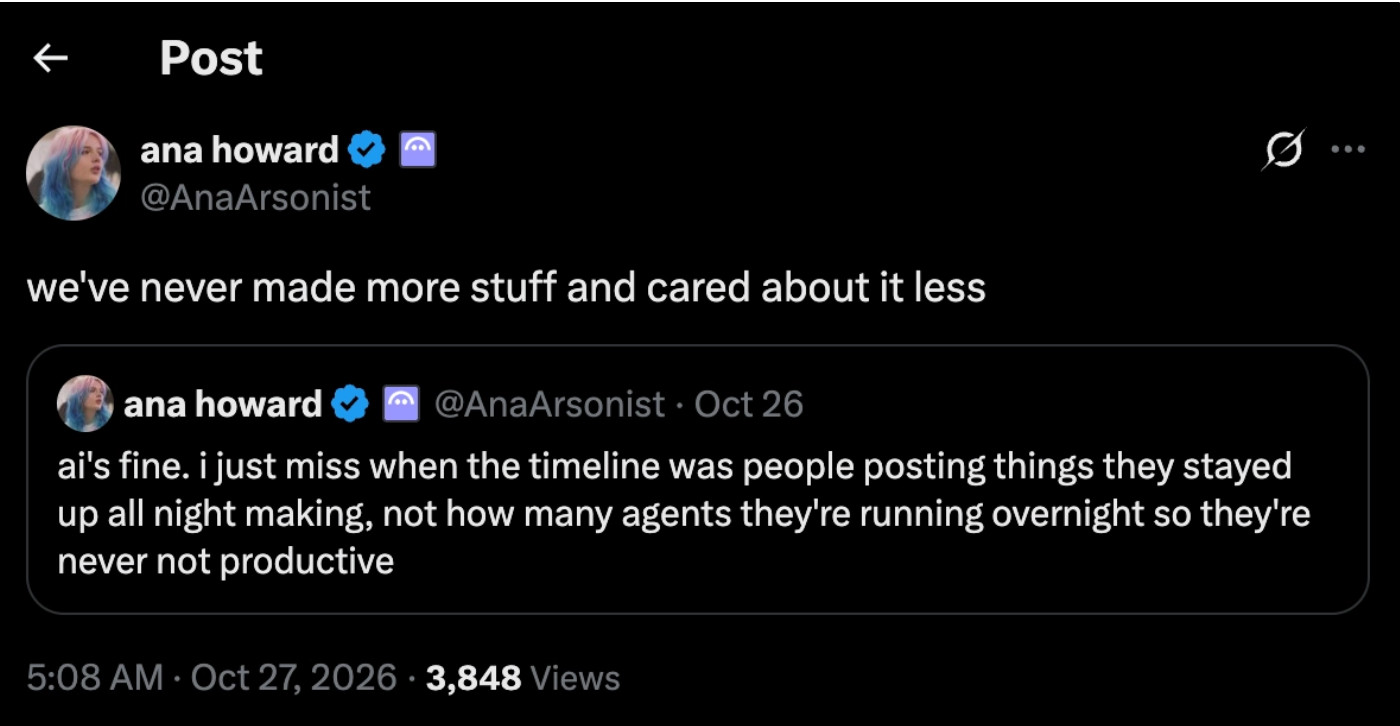
Image: Ana Howard on X
4. everything trends toward the mean unless you push back
ryo lu, former head of design at cursor, calls it convergence to the mean. a model trained on everything gives you the average of everything, so if you stop at the first output, you get what everyone else got. the real work is pushing past that average: cutting whatever feels like boilerplate until what’s left carries your unmistakable signature. also, good designers are opinionated enough to make strong calls in ambiguity, and the average is what you get when nobody makes a call.
5. the best tools teach you something
the ai tools i use sharpen my judgment. emil kowalski’s claude skills audit my work and name what’s off, like an inner radius that isn’t concentric with its container. they teach me the lexicon for a motion design concept i don't know, so i actually learn something new instead of outsourcing my brain to a model. i’m also turning years of notes on podcasts, books, and articles about product thinking into skills of my own, so when i ask for feedback, the reference is my own brain instead of the average of everyone else’s.
the tools will keep getting faster, and i'll keep using them. i just want to preserve that hesitation, the stretch where i don't yet know the answer. if we skip that every time, what's left that's ours?
Foundational reading
- Tuhin Kumar
- Objectified (Gary Hustwit)
- In Praise of Shadows — Jun’ichirō Tanizaki
- George Saunders
- Anne Carson
- Convergence to the Mean — Ryo Lu
- Craftspersonship — Anthony Hobday